 Flooring Correct
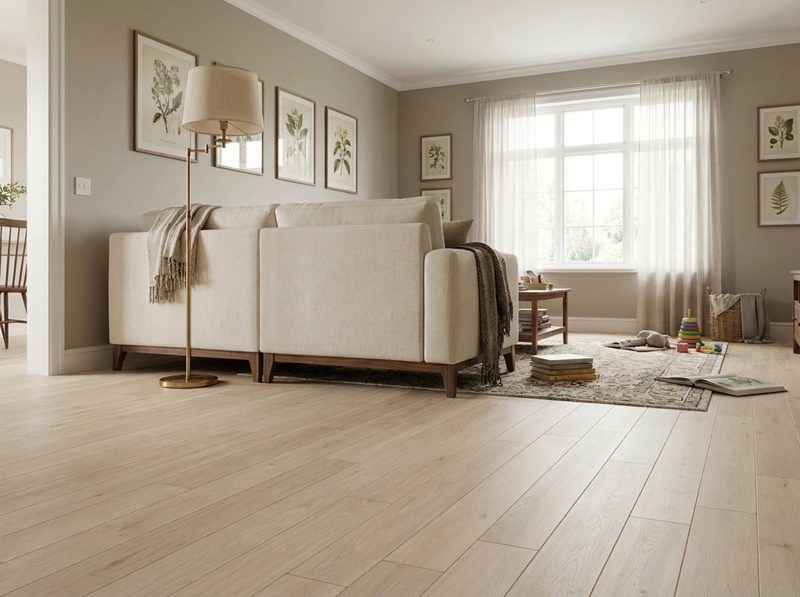
Plank width
What do strip, plank and wide plank mean?
Plank width is the face width of a board once it is down, meaning the part you see after the tongue is buried in its neighbor. The trade sorts widths into loose bands, narrow strip, mid width plank and wide plank, but those names are conventions rather than a standard. The only figure that governs is the coverage width printed on the spec sheet.
A wood floor is a room divided by a board. Whatever width you land on, the room is almost never an exact multiple of it, so there is a remainder, and where that remainder goes gets decided before the first board is fastened. It is the half of a width decision nobody mentions in the aisle, and it is the half you keep noticing every time you walk through a doorway.
The bands, and which number on the box you are reading
Strip is the narrow end, and it is the width most older American houses were floored in. Plank is the middle of the range and covers most of what a showroom rack carries. Wide plank sits above that, and mills use the term freely once a board is broad enough that a room takes only a handful of courses across it. Random width, sometimes sold as multi width, is two or three widths laid together in a planned sequence rather than one width repeated.
None of those names is a standard. They are trade conventions, and mills use them loosely, so the only number that means anything is the one on the spec sheet. Even then, ask which number it is. Some sheets list the nominal width of the milled board and some list the coverage width, meaning the face you actually see once the tongue is buried in the neighboring board. The tongue is not floor. Dividing the wrong one of those two numbers into your room gives you an answer that is close enough to feel right and wrong enough to matter.
The remainder has to land somewhere
Take the room dimension that runs across the boards, wall to wall, and divide it by the coverage width. You get a number of whole courses and a leftover. That leftover is not waste. It is a course, and it has to be ripped down the length of the room and fitted against a wall.
A good installer does not start with a full board at one wall and accept whatever the far wall gives him. He splits the difference, taking some off the first course so the last course lands at a similar width, because a sliver against one wall reads as an error even to people who could not say why. A sliver is also a weak piece of floor. Rip a board narrow enough and the tongue or the groove is gone with it, which leaves that course held by adhesive or a face fastener rather than by the joint it was designed around.
Width makes that arithmetic louder. On a strip floor the leftover is a fraction of an already narrow board, and splitting it between two walls is barely visible. On a wide plank floor the leftover can be nearly a full board or nearly nothing, and either extreme lands in plain sight.
Doorways, closets and the places it shows
A doorway is a short slot of floor with trim on both sides, which is where a rip is hardest to hide. A closet is the same problem with a smaller audience. An island, a hearth or a stair opening breaks the run and starts the arithmetic again on the other side of it. This is why the layout question and the width question get answered together rather than one after the other, and why the direction the boards run matters as much as how wide they are.
Where one room meets the next, the courses either continue through the opening or they stop and something covers the joint, which our entry on transitions and moldings works through in full. Continuing them through is usually the better looking answer and it constrains the width decision across both rooms at once, because the arithmetic now has to work in two rooms of different dimensions.
How a width choice actually fails
- A sliver course at one wall, too narrow to fasten properly and too obvious to ignore once the shoe moulding is on.
- A last course ripped past its groove, so the joint that was supposed to hold the edge down is no longer there.
- A wide face bridging a dip in the subfloor, which either moves underfoot or opens at a joint a season later. Our entry on subfloor flatness and squeaks covers what that dip does to a floor.
- Seasonal movement showing more plainly, since the same percentage of swelling buys more inches at a wide face than at a narrow one. The live answer on plank width works that mechanism through in full.
- Fewer and deeper edge lines than expected, since a wider board means fewer bevels carrying the same job. The bevel edges entry covers what each edge profile does.
The check you can run with a tape measure
You can do most of this at your own kitchen table before you order anything, and it does not take long.
- Measure the room across the direction the boards will run, at both ends of the room. Walls are rarely parallel and the difference between the two readings is the taper the first course has to absorb.
- Get the coverage width off the spec sheet rather than the product name.
- Divide, and look at what is left over. Split it in half, and that is roughly what the first and last courses become.
- Run the same arithmetic on the next width up and the next width down. One of the three usually lands noticeably better than the others.
- If you want the square footage and box count before you come in, our flooring calculator does that arithmetic for you.
Where the width decision gets made for you
Some of it is not yours to choose. The manufacturer's own instructions govern how a given width may be installed, the subfloor has a vote, and the construction of the plank sets how far a wide face can be pushed. The live answer on plank width takes all three of those apart, along with what width does to the scale of a room and how to judge it with full size boards on the floor.
Below grade, over a slab or over radiant heat, none of it is a preference. Engineered hardwood is the only route to a wide wood floor in those rooms, and the engineered category page sets out what we keep on the floor in Wentzville. Bring the room dimensions and we will do the division with you at the counter, or call 636-332-0654 and read them to us over the phone.
What else comes up about board width
Why the starting course gets ripped, what width does to a material order, and why length belongs in the same conversation.
636-332-0654Two reasons, and they stack. The first is the remainder: splitting it between the first and last courses keeps a sliver off either wall. The second is that walls are not straight. The starting course gets scribed to follow the wall it sits against, so that every course after it can run true instead of inheriting the wall's bow.
No. Coverage is sold in square feet, so the same room takes the same square footage at any width. What can shift slightly is the waste allowance, because ripping long courses down their length and cutting around doorways behaves differently at different widths, and because the length distribution in the carton changes how much of each board gets used.
More than people expect. A long board reads calm and a short one reads busy, regardless of how wide either is, and a wide board that is also short can look stubby in a large room. Length distribution is set at the mill and travels with the grade, so it is worth asking about alongside the width.
Wide boards, and the room that has to hold them
Tell us the room's short dimension, which way you want the boards to run, and what is on the floor now. We will do the division with you, and the free measure reads how flat the subfloor is before anything is ordered.
Free estimate
636-332-0654