 Flooring Correct
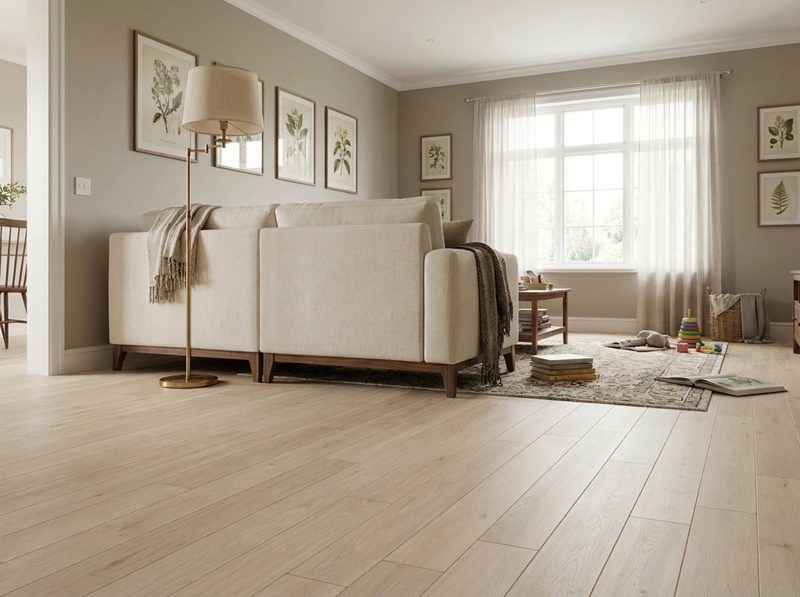
What plank width is in style right now?
Wide plank has been the prevailing look for long enough to read as the norm rather than a moment. Narrow strip now reads traditional rather than current. But fashion is only half of it. Wider boards move more with the seasons, and a board scaled for a great room can swallow a small one. Width is a design decision and a performance decision at the same time.
What width actually does to a room
Width changes a floor from a pattern into a surface. Narrow boards put a lot of lines in your field of view, and the eye reads the rhythm of those lines before it reads the wood. Widen the board and the lines thin out, the grain of each plank gets room to be seen, and the floor starts reading as one continuous plane with figure in it. That is the whole visual effect, and it is why the same species in the same stain can look like two different floors at two different widths.
Underneath that sits a scale relationship. A board has to look like it belongs to the room it is in. Lay a plank sized for a great room in a small bedroom and you can end up with only a handful of boards from wall to wall, which reads wrong in a way that is hard to name until you see it. Run narrow strip through a large open main level and the floor gets busy, and busy competes with everything else in the room for attention.
The mechanical half of the decision
Wood takes moisture from the air and gives it back, and it does nearly all of that movement across the grain rather than along the board. Here is the part that matters for width. The movement is proportional. A board that swells by a small percentage of its width gains far more in absolute terms at a wide face than at a narrow one. The percentage is the same. The inches are not.
So the seasonal behavior of a wide floor is more visible than the seasonal behavior of a narrow one, in both directions. The thin gaps that open in deep winter are wider between wide boards, and a damp spell shows at the edges sooner. None of that is a defect and all of it is manageable, which is what the Missouri humidity question works through in full. It does mean that in a house which is hard to keep steady, width is a specification with consequences rather than a preference.
Where engineered changes the answer
This is why so much of the wide plank on a showroom rack is engineered rather than solid. A cross laminated core physically restrains the wood above it, so the plank stays close to the width it was milled at through the year. The construction is what does the work, and it is the reason wide is a comfortable specification in engineered and a more demanding one in solid. If you want a wide board and your house swings hard between August and January, that is the honest route to it. Which construction belongs in which room is settled on solid versus engineered.
What the subfloor has to say about it
A wide board is a long straight edge, and a long straight edge is unforgiving of a floor that is not flat. Dips and humps a narrow strip would ride over telegraph through a wide plank, and a board that cannot sit flat will move underfoot or open at a joint later. Wide products also tend to carry stricter installation instructions, often calling for adhesive assist rather than fasteners alone. Which rules apply to the floor you like are printed on its own instructions, and the flatness of what is under your existing floor gets checked at the in-home measure.
Why the fashionable answer and the right answer part company
Flooring fashion turns over slowly and floors last a long time. That mismatch is the whole problem with choosing on trend. A width that is everywhere today will still be down when the paint, the furniture and the kitchen have each been changed once, and the floor is the one thing in the room that is not easily reversed.
Which is why the durable advice is to pick the width that suits the room and the house rather than the one having a moment. Mid scale ages best because it never announces itself. Wide belongs in rooms with the space to carry it. Narrow strip is not dated in a house that was built for it, and that last point gets missed constantly. A century old bungalow with new wide plank often looks like a renovation. The same house with a board close to its original width just looks right.
How to actually judge it
Not from a photo and not from a chip. Width is one of the few flooring decisions a small sample cannot communicate at all, because the effect only exists at room scale. Ask for full size boards, set several of them together on the floor of the room they are going into, and then stand up and look from the doorway. Look again in the morning and at night, because light does as much work as width does. Which way the boards run changes the effect as much as how wide they are, so decide the two together.
The floor finder narrows the field before you come in, and the racks of solid hardwood and engineered hardwood at the Wentzville showroom carry widths side by side so the comparison is in front of you instead of in your head. Bring a photo of the room and the dimensions if you have them. Call 636-332-0654.
What else people ask about plank width
Flatness, mixed widths and what happens to a wide board in a small room, answered straight.
636-332-0654It asks more of the conditions around it. A wide board's seasonal movement is larger in absolute terms than a narrow board's, so it shows humidity swings more plainly, and it needs a flatter subfloor because a long straight edge cannot bridge a dip. Engineered construction cancels most of the movement side. Steady indoor humidity and a properly prepared subfloor handle the rest.
Yes, and it is an old pattern rather than a new one. Multi width and random width floors lay two or three widths in a repeating or scattered sequence, which reads as older and more handmade than a single width does. It needs planning before the first board goes down, because the sequence has to be worked out for the room and the material ordered to suit it.
Usually something at or near mid scale rather than the widest board on the rack. The test is how many boards land between the walls. If a room only takes a few planks across its width, the floor reads as a handful of large panels instead of a floor. Set full size boards on that room's floor and look from the doorway before you decide, because no chip will tell you.
See the widths side by side
Tell us the rooms and roughly when you want it done. We will set full size boards together so you can see what width does before anything is ordered.
Free estimate
636-332-0654