 Flooring Correct
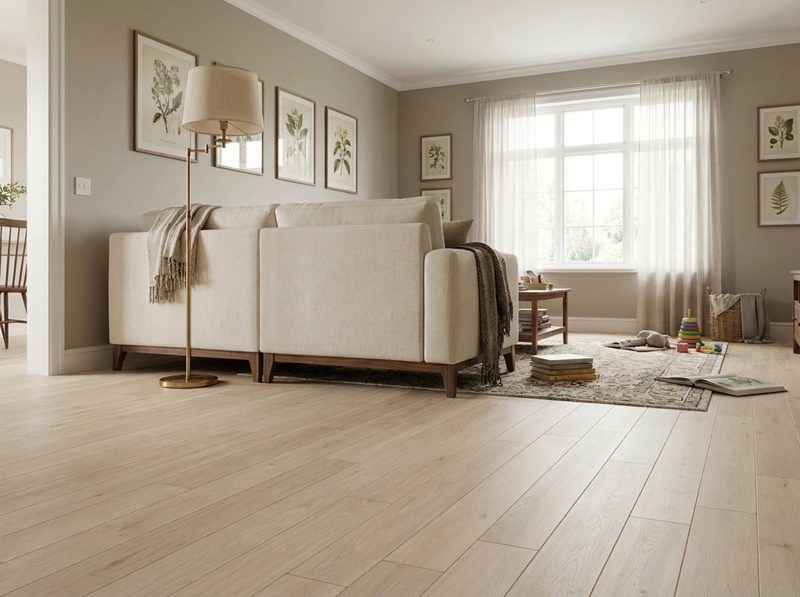
Why do hardwood floors gap in winter?
Because heating season dries the indoor air, and wood gives up moisture to dry air. Every board narrows slightly across its width, and that lost width shows up as thin lines at the seams. It is normal, it reverses in summer as the air gets humid again, and holding indoor humidity steadier through the winter keeps it small.
What the furnace is really doing to the room
It is not the heat that shrinks your floor. It is the dryness the heat creates. Cold outdoor air carries very little water in it. That air leaks into the house all winter through every door, every vent and every gap in the envelope, and once it is warmed to living temperature it becomes very dry air indoors. Every hour the furnace runs, the room your floor is in is thirstier than it was in September.
Wood responds by handing over moisture until it comes back into balance with that drier air, and as it does, each board loses a small fraction of its width. That exchange is the same mechanism at work before the floor is ever installed, running in the opposite direction. In spring the air outside gets humid, the furnace stops, and the boards take the moisture back and grow again. A wood floor does that every year it is down.
Why it looks like many thin lines and not one big one
The amount a board moves is proportional to how wide it is. A board loses a percentage of its width, not a fixed measurement, so a wide plank gives up more actual width than a narrow strip under exactly the same conditions. That is the whole reason wide plank floors show the season more plainly, and it is worth knowing before you choose rather than after.
In a healthy floor that shrinkage is shared out across every joint in the room. A hundred boards each give up a hair and you get a hundred hairline seams, which is why normal winter gapping reads as a faint, even pattern rather than one obvious crack. When the same total shrinkage collects at one or two joints instead, something has stuck boards together, and that is a different story.
Normal season, or a real problem
Here is how the showroom sorts one from the other when somebody sends a photo in February.
- Normal. Thin, fairly even lines spread across the room, wider as the heating season deepens, closing again through spring and gone by mid summer. Boards stay flat, the floor stays quiet underfoot, and nothing has changed at the edges of the room.
- Not the season. Gaps that are still open at the most humid time of year. That usually means the wood was wetter than the house when it went in, so it shrank once and stayed there.
- Not the season. One noticeably wide gap while the boards either side of it sit tight together. Several boards have bonded to each other, often through finish or adhesive across the seams, so the group moves as one piece and dumps all of its shrinkage into a single joint.
- Not the season. Gaps together with cupping, where board edges sit higher than their centers. Cupping means one face is wetter than the other, and the moisture is usually arriving from below rather than from the room air.
- Not the season. Gaps with movement, flex or a hollow sound underfoot. That points at fastening or at the subfloor, and it wants a look in person rather than a diagnosis from a photo.
What humidity control actually changes
It does not stop the floor from moving. It narrows the range the floor has to move through, and range is what does the damage. A humidifier plumbed into the furnace keeps indoor air from falling as far during heating season, so the wood gives up less and the seams stay finer. Our hardwood page gives the indoor relative humidity band worth holding to, roughly thirty to fifty percent through the year, and a floor kept inside it mostly behaves.
Two practical notes. Steady beats perfect: a house parked at one middling setting all winter treats its floor better than a house that swings hard between comfortable and bone dry. And humidity is not uniform inside a house, so a room over an unheated space, a room with a fireplace running, or the boards right in front of a supply register will read differently from the rest of the floor and can gap while the next room barely does.
Leave a winter gap alone
The instinct is to fill it, and filling a seasonal gap in January is the one move that turns a temporary cosmetic thing into a permanent one. Whatever you press into that seam is still there in July when the board comes back to full width. Then it either gets crushed and pops out in pieces, or it holds and the board crushes its own edge against it, which costs you width you never get back. Live with a first winter, watch the floor through a full year, and see what the range really is.
If a gap is genuinely still open at the humid end of the year, it is a floor question rather than a season question, and it has answers. Filling permanent gaps is usually done as part of a sand and refinish rather than on its own, which is one of the quiet advantages of solid wood, since it can be taken back and made new more than once.
Choosing a floor that shows it less
If you are still choosing rather than living with it, the specification does some of this work for you. Narrower boards move less in absolute terms. Engineered construction moves less again because its core is built to cancel the movement out. Prefinished boards carry a small bevel at each edge, so a fine seasonal line falls into a shadow that was already there, while a floor finished in the house has no bevel and shows the same movement more openly. Which of those is right for your house is the whole subject of hardwood in Missouri humidity. Bring the room and the questions to 15570 Veterans Memorial Pkwy in Wentzville, or call 636-332-0654 and ask somebody who sells and measures wood floors every week.
More on floors that move with the season
Whether they close, whether to fill them, and how engineered construction changes the picture.
636-332-0654Normal seasonal gaps do. As the outdoor air turns humid in spring and the furnace stops running, the boards take moisture back and widen to close the seams, usually finishing by mid summer. If the same gaps are still open at the most humid point of the year, they are not seasonal and something else caused them, which is worth having somebody look at.
Not in winter, and usually not at all as a standalone job. A seasonal gap is going to close on its own, and anything packed into it gets squeezed when the board returns to full width. It either breaks up and leaves a ragged line or crushes the edge of the board. Permanent gaps get filled properly as part of a sand and refinish instead.
Much less, and that is the main reason the category exists. The layers in an engineered core are turned across each other so they physically restrain the movement, which keeps the plank close to the width it was milled at through both seasons. It is still wood and it is not completely still, but the seams stay far quieter than on a wide solid plank.
Have somebody look at the floor
Tell us the room, the age of the floor and what it is doing. If it is the season we will say so, and if it is not we will tell you that too.
Free estimate
636-332-0654