 Flooring Correct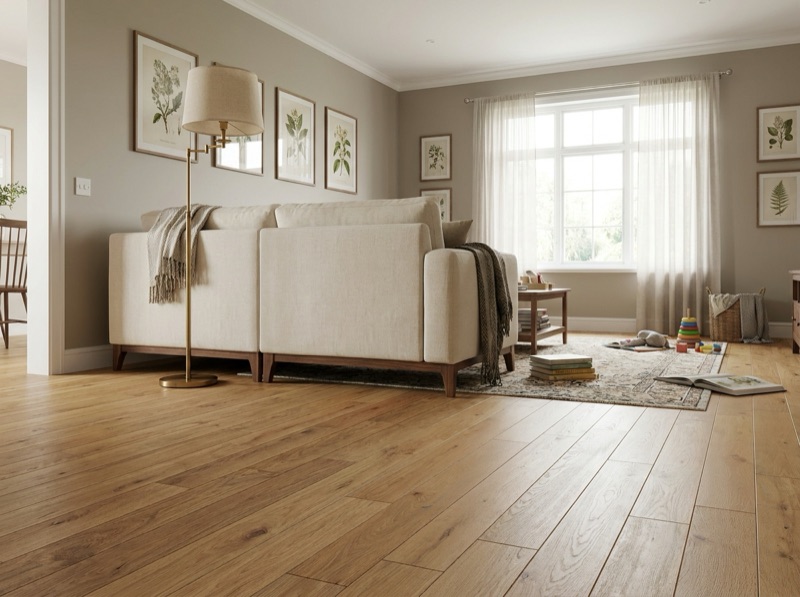
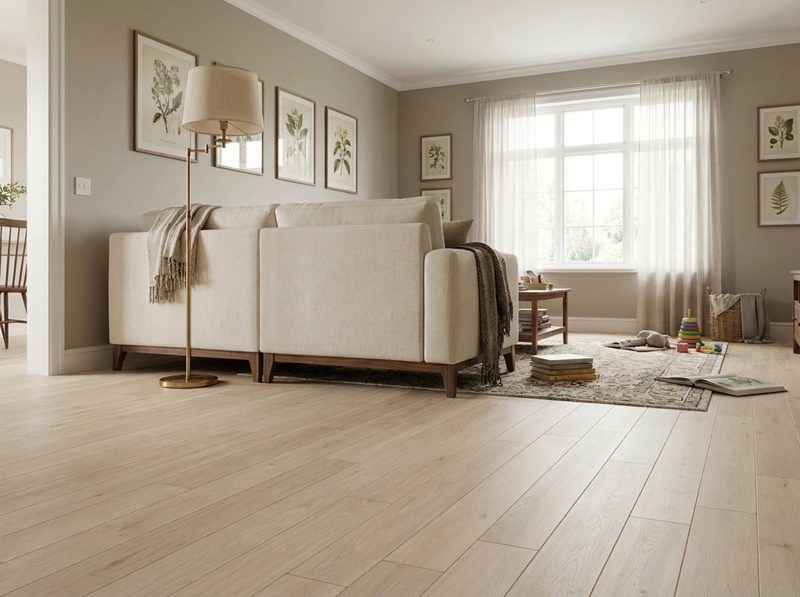
Is hardwood a good idea in Missouri humidity?
Yes, with conditions. Wood floors do fine here in houses that stay conditioned year round, because the problem is not humidity itself but how far a house swings between a humid summer and a dry heating season. Keep the indoor air steadier, match the construction to what is under the floor, and be honest about plank width.
The swing is the variable, not the summer
People ask this question because they are picturing an August afternoon in St. Charles County, and August is not really the issue. A wood floor in a place that is humid all the time settles at humid and stops arguing. What tests a floor is a house that spends part of the year damp and part of the year running a furnace against cold, dry outside air. Our year has both, in sequence, every single year the floor is down.
So the honest answer is not a yes or a no. It is a set of conditions. Meet them and a wood floor lives here happily for decades, which is why so many houses in this county have one. Ignore them and the floor spends its life at the far ends of its range, which is where seasonal gapping stops being cosmetic and cupping becomes a summer conversation.
First condition: a house that stays conditioned
This is the one that decides most of the rest, and it is a question about the house rather than the floor. Air conditioning through the humid months does a lot of quiet dehumidifying as a side effect of cooling. A humidifier on the furnace holds the winter end up. A bath fan that actually vents outside instead of into an attic keeps a shower out of the framing. Our hardwood page gives the indoor humidity band worth aiming at, and a house that can hold it has already passed the hard part.
The houses we get careful about are the ones that cannot. A second home that sits shut up and unconditioned for weeks. A property between owners with the utilities off. A basement that is feeding moisture into the floor above it. A house in the middle of construction, which is a different climate again. If the space is going to live at whatever the outdoors dictates, that is not an argument against wood so much as an argument for a construction that does not care, and sometimes for luxury vinyl plank instead.
Second condition: what is underneath the room
On grade and above grade over a wood subfloor is solid hardwood's home ground, and in a conditioned house it is a straightforward yes. Over a concrete slab or below grade the answer changes, and it changes because of what the slab is doing rather than because of the weather. That case is settled in full on our basement flooring page and on hardwood on a concrete slab. Read those before you fall in love with a solid board for a lower level.
Third condition: be honest about plank width
Wood moves as a percentage of its width, so a wide board gives up and takes on more actual width than a narrow one under identical conditions. A wide plank floor is not less stable as a material. It just expresses the same seasonal movement in bigger, more visible increments, and it does that in a house where the current look is as wide as people can get.
That is not a reason to give up the look. It is the reason wide and engineered go together so naturally around here. If you want a genuinely wide face in a Missouri house, engineered is the specification that gets you there without gambling. If you want solid, a moderate width is the conservative call, and it is what we steer toward in a house that is difficult to keep steady.
Solid or engineered, decided on your house
We sell both, so we have no reason to push either. The split falls out of the conditions above rather than out of quality, because engineered is real wood and is not the lesser option.
- Solid makes sense on or above grade, over a wood subfloor, in a house you keep conditioned, at a moderate plank width. Its advantage is that it can be sanded back and recolored more than once, which is a long game worth playing.
- Engineered makes sense over a slab, below grade, over radiant heat, at wide plank faces, in a house that swings, or when you want the same floor to carry down a stair into a lower level.
- Either way the wood still has to come into balance with your rooms first, which is its own step before install day and is not optional in this climate.
- The full head to head, room by room, is on our solid versus engineered page rather than repeated here.
Finish changes what the season looks like
This part gets overlooked and it matters more here than in a mild climate. A floor finished in the house is coated after the boards are down, so the film runs continuously across every seam. When the boards shrink in a dry January, that film has to give somewhere. On a floor that moves a lot it can split fine lines along the seams, or hold a few boards together so their combined shrinkage opens one wide gap somewhere else in the room.
Prefinished boards are coated individually at the factory before they ever meet each other, and each one carries a small bevel milled at the edge. Nothing bridges the joint, so nothing tears, and a fine seasonal gap disappears into a shadow line that was already part of the look. Neither approach stops the floor moving. They just show it differently, and in a house with a big annual swing that difference is worth weighing. Bring your rooms and what is under them to 15570 Veterans Memorial Pkwy in Wentzville, or call 636-332-0654 and we will tell you which way we would go and why.
What people ask before committing to wood here
Humidifiers, engineered versus solid, and whether the wide look is realistic in this climate.
636-332-0654In most houses here it is the single most useful thing you can add, because it stops the indoor air falling as far during heating season and keeps the wood from giving up as much moisture. It does not stop the floor moving, it narrows the range it moves through. A bath fan that vents outside and air conditioning through the humid months handle the other end of the year.
Safer against movement, yes, and that is a real advantage in a house that swings or over a slab. It is not automatically the better floor. A solid board in a conditioned upstairs room can be sanded back and refinished more times, which matters if you plan to keep the house a long while. We stock both and the recommendation comes from the room rather than the category.
Yes, and most people who want them should have them. Just understand that width and movement scale together, so a wide face shows the season more than a narrow strip does. The comfortable way to get a wide look in this climate is an engineered plank, where the core holds the board to size. Wide solid boards are still possible in a house you keep steady.
Settle it on your actual house
Tell us the rooms, what is under them and how the house is conditioned. We will say which construction we would put in it, and the estimate and measure are both free.
Free estimate
636-332-0654