 Flooring Correct
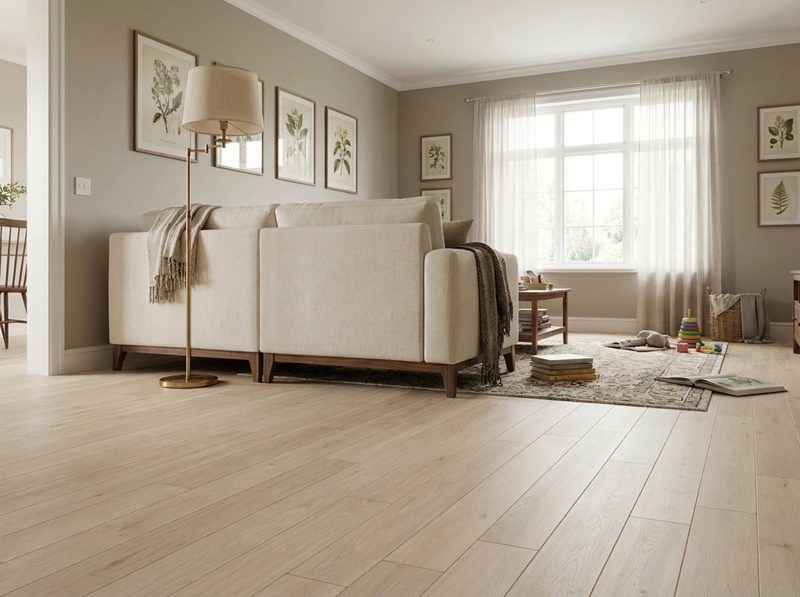
Bevel edge
What is a bevel edge on a floor plank?
A bevel is the small angled cut along a plank's edge, so the joint between two boards reads as a fine groove instead of a flat plane. A square edge has none, a micro bevel has a shallow one, and a full eased or pillowed edge carries a deeper, more visible groove.
This reads like a look question and it is not only a look question. The edge profile on a plank decides how forgiving the floor is over a subfloor that is not perfectly flat, how a thin winter gap between boards reads from the doorway, and whether the finished room looks like one continuous wood surface or a field of separate boards.
The three profiles you will be shown
Every prefinished plank leaves the mill with one of three edges, and the spec sheet names which.
- Square edge. No chamfer at all. Board meets board on a flat plane and the joint is a hairline. This is what a floor sanded in place looks like, because that floor was brought flat after it was down.
- Micro bevel. A shallow chamfer, sometimes barely more than a broken corner. It catches a fine shadow line and reads as quiet definition between boards. This is the default on most prefinished wood.
- Eased or pillowed edge. A deeper, rounder chamfer that reads as a visible groove between planks. It emphasizes each individual board and belongs to rustic and wide plank looks.
What a bevel is really there to absorb
A floor finished in the house gets sanded flat in the room, so every board is brought to the same plane after installation. A prefinished floor never gets that pass. It arrives already coated, whether it is solid or engineered, and whatever small differences exist between board thicknesses, and whatever gentle undulation exists in the subfloor, stay in the finished surface.
A bevel absorbs those differences. Where two boards sit a hair apart in height, the chamfer turns what would be a ridge you can feel with a bare foot into a shadow you cannot. It does the same work seasonally. Wood gives up moisture through a Missouri winter and the boards narrow slightly, and a hairline gap that would be glaring along a square joint disappears into the groove of a beveled one. Acclimation and indoor humidity are what set the size of that movement in the first place.
That is why a square edge on a prefinished plank asks more of the installation. The subfloor has to be flatter, and how flat a subfloor actually is is a measurable thing rather than an opinion. Skip that step and the ridges announce themselves in the first month.
Conditions that point to a square edge
- You want the floor to read as one surface. Square edge is the closest a prefinished plank gets to the look of a floor sanded in place.
- Narrow strip or standard width boards. The narrower the plank, the more joints per foot, and a visible groove at every one of them starts to read as stripes.
- A traditional or formal room where the wood is meant to sit quietly under the furniture rather than announce each board.
- A flat, sound subfloor, or a willingness to do the preparation that gets it there before anything is fastened down.
Conditions that point to a bevel
- Wide plank. A wide board wants definition or the floor reads as one flat sheet, and width changes a room on its own before the edge is even considered.
- A slab, a basement or any floor where perfect flatness is a fight rather than a given.
- Hand scraped, wire brushed or character grade wood, where the entire point is that every board is its own thing.
- A house that swings hard between a humid August and a furnace-dry January, where some seasonal gapping is coming and you would rather it hid.
- A room with long, low light crossing the floor, which is exactly the light that finds every height difference a chamfer would have swallowed.
The edge also turns up where the floor stops
People decide this in the middle of a room and then meet it again at the edges. A stair tread on a hard surface floor needs a nosing at every tread, and the nosing has to carry the same profile as the field boards or the eye catches the mismatch on the way up. Stairs are their own problem for other reasons too, and that page settles them.
The same thing happens at doorways. Where wood meets tile or carpet, a transition strip has to sit down against a plank edge, and a deep chamfer changes how that joint reads and how much dirt gathers at it. Transitions and moldings get chosen alongside the floor, not after it, and a bevel is one of the things that decides which profile looks right.
Reducers, thresholds and the piece that meets a hearth all come from the same run of material, which is worth knowing before you narrow to one product. If the trim pieces for a plank are limited, a decision about the field of the room quietly becomes a decision about six other joints in the house.
Two sided, four sided, and why one sample cannot settle it
The other half of the specification is which edges got the treatment. A four sided bevel chamfers the long edges and the ends, so every board reads as a discrete rectangle. A two sided bevel chamfers only the long edges, so the run reads continuous down its length and the end joints nearly vanish. The visual difference between those two on the same product is larger than most people expect, and it is printed on the spec sheet as one line nobody reads.
That is also why a single sample board is useless for this decision. A bevel is a property of a joint, and one board has no joint. Ask for two planks of the same product, lay them edge to edge on the floor of the room they are going in, then stand up and look down at them from standing height rather than crouching over them. Do it again with a piece of your existing trim beside them, because a deep groove next to heavy traditional casing reads very differently than it does next to a slim square baseboard.
One myth worth putting down. Bevels do not meaningfully collect dirt. They hold slightly more dust than a flat surface, a vacuum takes it back out, and on a prefinished board the coating runs down into the groove, so the chamfer is finished rather than raw wood. What a bevel will not tolerate is a wet mop, and neither will the flat part of the board. Wood floors fail early from water and grit, not from an edge profile. If you want to settle it honestly, ask for two planks of the engineered wood line you are leaning toward and look at them at the hour of day the room is brightest. Call 636-332-0654 and we will have them ready.
What else people ask about plank edges
Whether a bevel can be sanded away, what it says about quality, and which profile forgives a subfloor.
636-332-0654Sanding a beveled floor flat means removing enough wood across the entire surface to erase every chamfer, which takes far more material than a normal refinish and is rarely worth it on a plank with a limited amount of wood above the core. People who want a flat floor buy a square edge or have the floor finished in place.
No. Edge profile is a design decision made at the mill, not a grade. Deep chamfers appear right across the range of wood floors and so do square edges. What actually reports on quality is milling consistency, the wood above the core and the finish, and the bevel tells you nothing about any of the three.
A deeper eased edge, and it hides rather than fixes. A chamfer can absorb a small height difference between two neighboring boards so you never feel a ridge underfoot. It cannot absorb a dip across a room, which shows up as bounce, hollow sound and stressed joints no matter what the edges look like.
Put two planks together before you decide
One board cannot show you a joint. Ask for a second plank of the same product, set them edge to edge on the floor of the room they are going in, and look at them from standing height. Bring a piece of your trim and we will start at the counter.
Free estimate
636-332-0654