 Flooring Correct
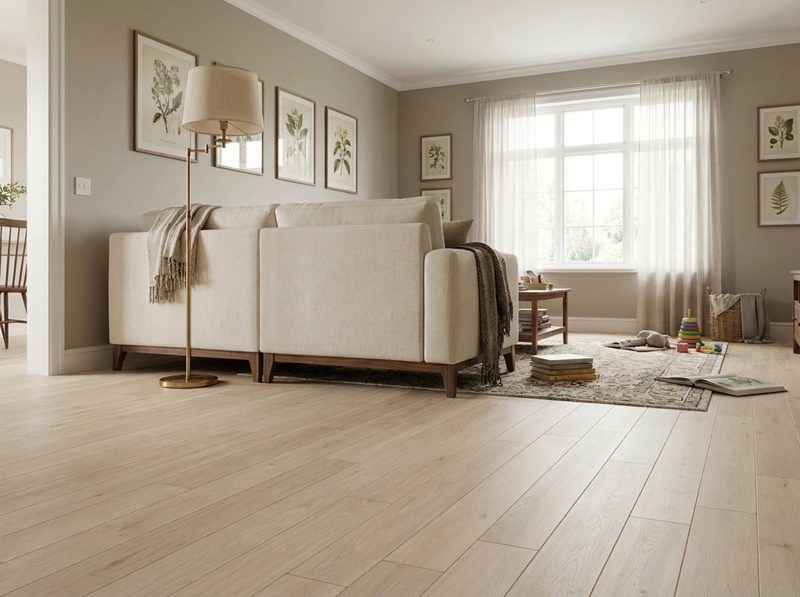
Rectified tile
What is rectified tile?
Rectified tile has had its edges ground or sawn square after firing, so every piece in the run measures the same and meets its neighbor at a sharp corner. That precision is what lets a floor be set with a narrow grout joint. It describes the edge only. It says nothing about density, wear class or wet grip.
Two tiles can come out of the same line, the same color and the same box and still not measure the same. Clay shrinks in the kiln, and it does not shrink evenly. Rectification is the extra step that takes that variation back out of the edge after the tile has already been fired, and everything people like and dislike about rectified floors follows from it.
What a kiln does to an edge
A pressed tile is formed damp, dried, then fired, and what comes out of the kiln is smaller than what went in. Shrinkage is predictable across an average and sloppy in any single piece, so a production run leaves with slightly different facial dimensions and a slightly soft, rounded edge, the one the trade calls a cushion edge. That edge is not a defect. It is simply what a fired edge looks like when nothing is done to it afterward.
Rectified tile gets one more operation. Once it is fired and cool, each side is run past grinding wheels or a wet saw and cut back to a common dimension. The piece now measures what the box says it measures, piece after piece, and the edge meets the face at close to a right angle instead of easing away from it. The dimensional language behind all of this sits in the tile product standard, ANSI A137.1, which is where the facial dimension tolerances printed on a spec sheet come from.
What a square edge buys you at the joint
Grout joint width is not a free style choice. It is set by the worst variation in the box, because the joint is the thing that absorbs it. The installation standard, ANSI A108.02, says it directly: the joint should be at least three times the actual variation in the tile supplied. Squeeze a joint tighter than that and the variation has to surface somewhere, normally as a joint line that visibly wanders in width across the room.
So rectification is really a joint width purchase. Take the variation out of the edge and the joint is allowed to shrink. Rectified porcelain is commonly set at joints down around 1/16 of an inch. A pressed tile with a cushion edge needs a wider joint than that, and how much wider is not a style question either: the joint still has to clear three times whatever variation the boxes in front of you actually contain, and a cushion edge leaves more of it in. What a particular tile will hold is printed on its own spec sheet as a minimum joint width, and that is the number to read rather than the number to assume.
From standing height a narrow joint changes the floor more than most people expect. Less grid, more field, and a large tile that starts reading like a slab instead of a pattern. The tile category page already covers matching grout color to the tile so a floor reads as one surface. Joint width is the other half of that same effect, and the grout entry picks up the color and the grout type from there.
The failure mode a cushion edge used to hide
A rounded edge is forgiving by accident. Where one tile sits a hair proud of its neighbor, two soft edges ease into one another, and your eye and your bare foot both let it pass. Grind those edges square and there is nothing left to hide behind. The same small height difference now reads as a shadow line running the length of the joint, and it catches a toe, a chair glide and a mop head.
That is why rectified tile puts the pressure on the subfloor rather than on the tile. The flatness a floor needs before big tile goes down is spelled out on the tile page, and an out of flat substrate is the most common reason a rectified floor disappoints someone who paid attention to everything else. Flattening happens before the first tile is set. There is no fixing it afterward with grout.
Two more things a square edge does not solve. Warpage belongs to the tile body itself, so a long plank tile with a slight crown through its middle stays crowned no matter how true its ends are, which is exactly why staggered layouts on long formats get held to a shallow offset. And a tile field still needs soft movement joints where it meets walls and at intervals across a long run. A narrow joint gives a floor less room to move with the season, not more. The subfloor entry covers what flat actually means and how it gets measured.
Checking the edge yourself, standing at the rack
This is one of the few specifications you can settle with the tile in your own hands, without taking anyone's word for it. Pull two pieces off the display and try these in order.
- Stand the two tiles face to face and hold them up to a light. Ground edges sit flat to flat with no daylight along the join. Cushion edges leave a thin lens of light running the length of the pair.
- Run a fingernail off the face and over the edge. Square catches your nail. Rounded lets it slide off.
- Set four pieces down dry, corner to corner, on a flat surface. Rectified corners arrive at a point. Pressed corners leave a small dimple where four eased edges meet at once.
- Look at the edge under a light. A sawn or ground edge shows a matte cut face, often a shade off the glaze. A fired edge is smooth and continuous with the face.
- Compare two tiles from two different boxes rather than two off the same stack, and measure both across the same direction. Whatever difference you find is the amount the grout joint has to swallow.
When it earns the extra care and when it does not
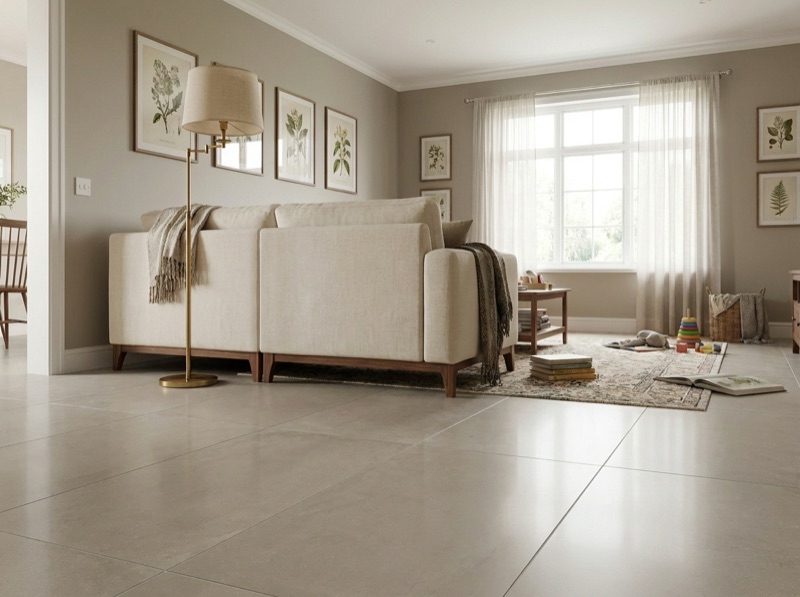
Rectified pays off where the floor is meant to read as one surface and where light travels along it rather than straight down onto it. A large open kitchen. A great room in porcelain. A shower wall lit from the side. A long entry catching low winter sun through the door. In those rooms the grid of joints is doing most of the visual work, so shrinking the grid changes the room more than changing the tile color would.
It matters less where cabinets, furniture and rugs break the floor up anyway, and it is the harder choice on a floor pitched to a drain or laid over a subfloor with a history. A pressed tile at a wider joint is not a lesser floor. It is a floor with tolerance built into it, and in some rooms that tolerance is the entire point. Format and the body of the tile both do more for how a floor lives than the edge treatment does.
The honest trade is preparation. A narrow joint asks for a flatter floor and slower, fussier setting, and that is a labor and subfloor question rather than a tile question, which is why it gets settled in your house with the actual floor underfoot rather than at the counter. Tell us the room and what is under it now and we will tell you what that subfloor is likely to allow. Call 636-332-0654, or come by the showroom in Wentzville and put four pieces on the floor before anything gets decided.
What people ask once they hear the word rectified
Whether it means better tile, whether the grout joint goes away, and how to tell which edge you are holding.
636-332-0654No. Rectification is a cut made after firing, so it changes the edge and nothing else. Density, wear class and wet grip come from the body and the surface of the tile, and a pressed tile can beat a rectified one on all three. Read the wear and slip ratings separately from the edge description.
Yes, always. The joint absorbs the remaining dimensional variation, gives the floor somewhere to move as the house expands and contracts through a Missouri year, and takes the abuse at the vulnerable edge of each piece. Butting rectified tile tight together with no joint is how edges chip and how a field cracks later.
The sample tag and the manufacturer spec sheet say so outright, usually alongside the recommended minimum joint width. If neither is in front of you, the fingernail test on the edge settles it in a couple of seconds. Ask at the counter as well, because the answer changes what joint width the floor can be set at.
A tight joint starts with the floor under it
Tell us which room you want reading as one surface, and what is under it now, plywood or slab, flat or not. The free in-home measure settles whether that floor is ready for a narrow joint before any tile is ordered.
Free estimate
636-332-0654