 Flooring Correct
Tile sizes and formats
How do you pick a tile size and format?
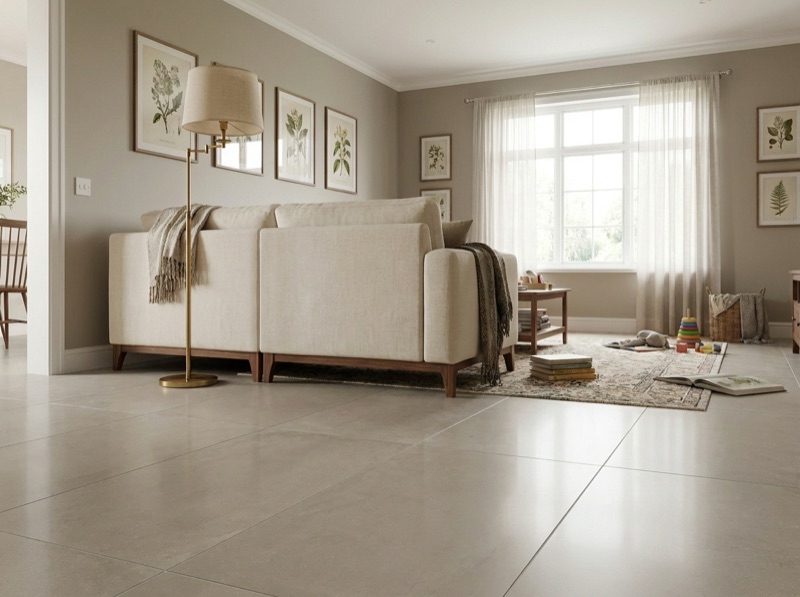
Format means the size and shape of the piece: small squares and mosaics, field tile like 12 by 24, big squares, or long plank porcelain. Pick it by the room rather than the trend. Room dimensions, how many cut pieces the layout forces, whether water has to reach a drain, and how flat the subfloor is decide it between them.
Color usually gets settled early, in the first few minutes at the rack. Format takes longer and matters more. The same porcelain in a 12 by 24, a big square and a long plank gives you three different floors, with three different joint counts, three different cut lists and three different demands on whatever is underneath.
The four shapes that cover almost every floor
Tile catalogs run to hundreds of sizes, but a floor decision usually comes down to one of four families, and knowing which family you are in is most of the work.
- Small format, roughly hand sized and down. Squares, hexagons, the classic subway shape that is twice as long as it is tall. More joints per square foot, more texture underfoot from those joints, and enough pieces to follow a curve or a slope.
- Field tile, the working middle of the market. A 12 by 24 has become the default floor tile around here, with the big square close behind. Large enough to quiet a room down, small enough that an ordinary floor can carry it.
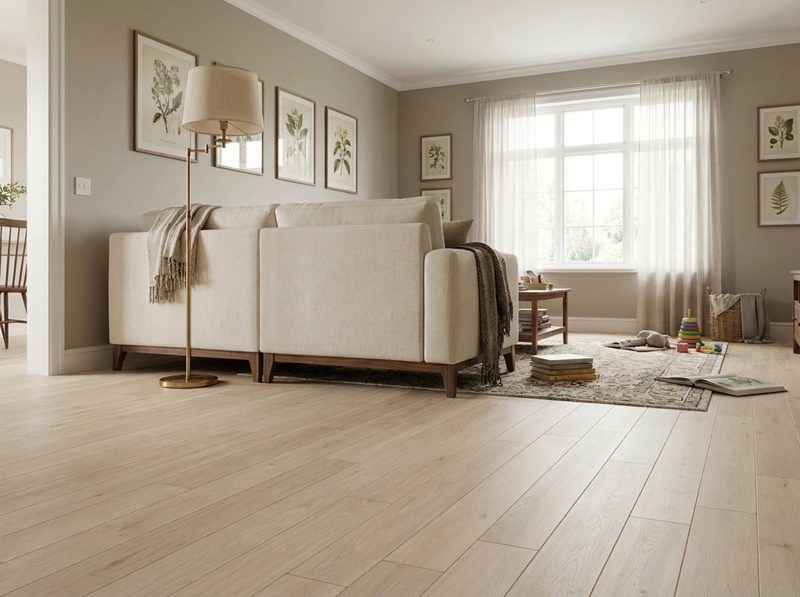
- Plank porcelain, long and narrow, in shapes like 8 by 48. It gives a wood look you can mop and it gets staggered like a wood floor, though it follows the layout rules of a long tile rather than the rules of a plank.
- Mosaic sheets, small pieces mounted on mesh or paper so a whole sheet sets as one piece. That format carries its own rules, and the mosaic entry works through them.
The line the trade draws between medium and large format sits at a side of 15 inches, and crossing it changes what the subfloor is obliged to do, which the tile category page lays out in full.
What the room does to the format
Every format eventually meets four walls, and the walls do not care what size you bought. In a small bathroom a large tile spends most of its life as a cut piece, so the wide open field you were choosing for ends up on the wet saw. This is arithmetic you can do before you order. Measure the room, divide by the tile, and look hard at what the last row turns into.
The detail people live with for years is a sliver cut landing at the most visible wall. Shifting the layout so the perimeter cuts come out generous and even on both sides is a decision made with a tape measure and a pencil, not something to leave to install day, and it sometimes argues for a smaller tile in a small room even when the bigger one won at the rack.
A big room returns the favor in the other direction. Fewer joint lines across a wide floor keeps the surface quiet and lets the eye travel, which is most of the reason plank and large field tile took over open main levels. Grid density is the real variable here. Halve the tile size and you roughly double the length of joint you clean and reseal for the life of the floor.
Where the water goes, the format follows
A shower floor is pitched to a drain, which means it is not flat, and a tile that cannot follow that pitch either rocks or holds water. Small pieces on a sheet lie down on a compound slope. A large tile cannot, short of being cut into small ones. That is why a shower floor and a niche so often end up in mosaic while the walls around them stay in big field tile.
The bathroom floor outside the shower has a different requirement, and it is not size, it is wet grip. The slip rating entry covers the number to look for on the tag. Format helps at the margin, since more joints across the same area give a wet bare foot more to hold, but the rating is what decides whether a tile belongs on a floor that gets wet at all. What standing water does to a room over the years is settled on the bathroom page.
What is underneath sets the ceiling on size
Big tile is far less forgiving of a floor that is not flat, and the flatness tolerance a large format calls for, measured across a long span rather than underfoot, is spelled out on the tile page. Get your format ambition and your subfloor reality into the same conversation early, because when those two disagree, one of them has to give, and it is never the physics.
On a wood subfloor the question is flatness and stiffness together, since a floor that flexes under a heavy step will telegraph into a rigid tile field. On a slab it is flatness plus whatever the slab is doing with moisture. Either way the answer is a flattening step before any tile is set, with patch or a self leveling compound, and that step belongs in the plan rather than turning up as a surprise. The subfloor entry covers how flat counts as flat.
Edge treatment tends to travel with format as well. Long and large tiles are most often sold with ground edges, which opens a separate decision about how narrow the grout joint can run, and the rectified edge entry handles that one.
What to bring when you come to choose one
Format does not survive a phone screen, and a sample chip the size of a coaster tells you the color while telling you nothing about the joint count, which is the part you actually live with. Come in with four things and the conversation gets short.
- Room dimensions, including the closet and the doorway. A tape measure settles most of this argument before it starts.
- A photo taken from the doorway, so the light and the sight lines are in the room with us.
- The cabinet door, the trim piece or the counter chip the tile has to live beside.
- Whatever you know about the subfloor. Plywood or slab, what came off it last, any spot that has ever felt soft underfoot.
Then ask for full pieces instead of samples and set four of them down together on the floor. Four tiles show you the joint grid, the shade variation across pieces and the true scale of the format, and none of the three shows up on a single chip. Wall selection runs by different rules, and the wall tile page covers those. Call 636-332-0654 if you want a specific size pulled before the drive, or come to the showroom at 15570 Veterans Memorial Pkwy and we will lay the formats out on the floor with you.
The size questions that come up at the rack
Whether big tile flatters a small room, whether one line runs several sizes, and how much extra to order.
636-332-0654Usually it helps, because fewer joint lines make the floor read as one surface instead of a grid, and a grid tells your eye how small the room is. The effect reverses if the room forces most of the field into cut pieces. Draw the room to scale against the tile before assuming bigger wins.
Often, and it is worth asking. Plenty of lines run a family of formats in the same body and color, so a field tile, a narrow band and a mosaic sheet can come from one product instead of three near matches. That is how a shower floor and a niche end up genuinely matching the walls.
It depends on the layout, the pattern and how chopped up the room is, because every cut piece leaves an offcut that may or may not be usable elsewhere. That waste figure gets worked out at the measure with your real dimensions. Keep the leftover box afterward, since matching a run years later is a hunt.
Bring the room, not just the color
Come in with the room's dimensions, a photo from the doorway and the cabinet door or counter chip it has to match. We will set full pieces of each format on the floor together so you can see the joint count before anything is ordered.
Free estimate
636-332-0654