 Flooring Correct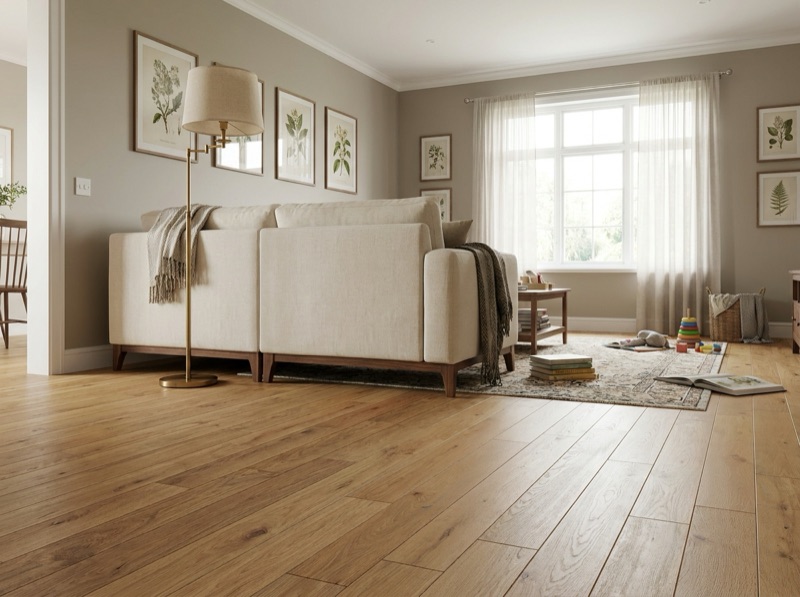
What flooring is best for a retail store?
There is no single best. Retail pulls two ways: a floor that flatters merchandise under display lighting, and a floor that survives carts, pallet jacks and the grit that walks in the door. Most stores land on glue-down luxury vinyl or tile on the sales floor, with the entry treated as its own floor.
The commercial page settles the surfaces in a line, and it is the right line: hard surface across the sales floor, with the door handled as a separate problem. What it does not do is say what that line costs you, because the two halves of it pull against each other and you will be giving something up whichever way you lean.
What you gain by specifying for the light
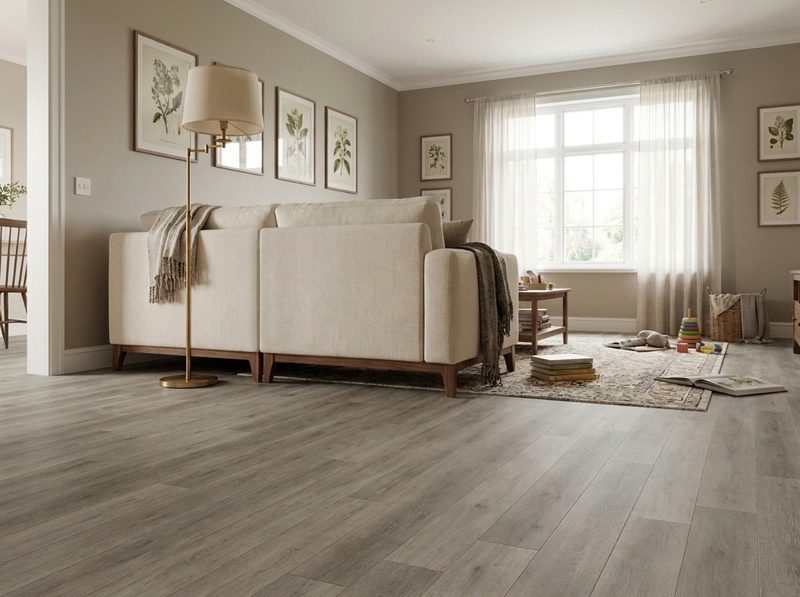
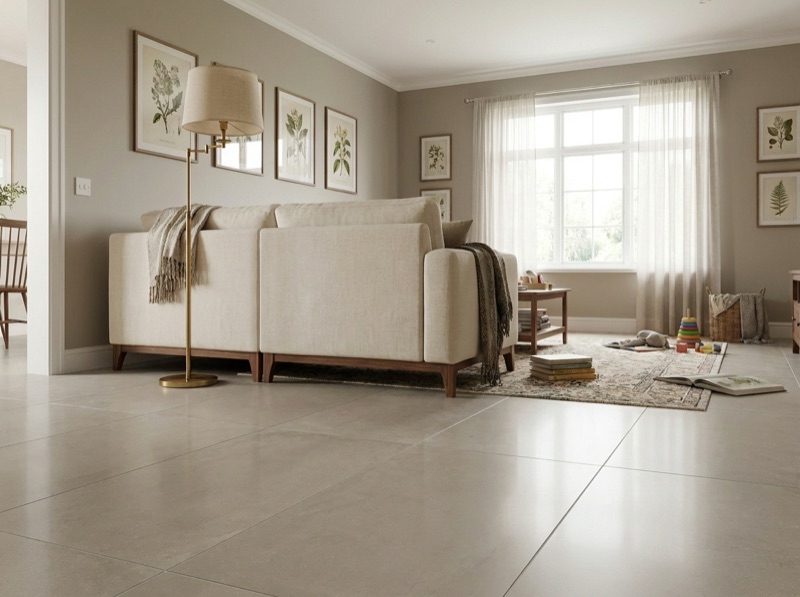
A retail floor is a background for merchandise and it is lit on purpose, usually with track heads and spots and plenty of them. A floor chosen for that setting tends to be larger format with fewer joints, carries a little more sheen so light travels down an aisle, and gets its color picked against the fixtures rather than against a paint chip. The gain is real, which is why people specify this way. Merchandise reads cleaner over a quiet floor. A long uninterrupted plane makes a small store feel larger. Light coming back off the floor fills the underside of shelving, which is where product actually sits.
What that costs you the moment the doors open
Sheen is the thing that turns on you. A floor with gloss shows every scuff, every black heel mark and every cart wheel skid, and it shows them under precisely the lighting you installed to flatter the merchandise, because raking light across a shiny surface is how anybody finds a defect. It shows footprints and it shows the mop path too. A matte or textured surface hides all of that, and gives up some of the depth that made the glossy sample look the way it did on the rack.
Color runs the same trade. A very pale floor swallows dust and disappears, a dark floor shows every crumb and every drip and photographs beautifully. Mid tones with movement running through them are where most stores end up, for the dull reason that they hide what a store produces all day long. Which floor colors hide dirt is a question in its own right.
What you gain by specifying for the traffic, and what that gives up
The other direction is to spec for what the store does to a floor. That means bonded down rather than floating, because a floating floor under a loaded pallet jack has nothing holding it in position and the joints end up doing that work. It means a construction and a wear layer rated for contract use, which is what the commercial page means by a wear layer built for a building, and which specification sheet you are actually reading is what settles whether a line qualifies, since the badge on the box will not tell you. And it means keeping the format sensible enough that a damaged piece can be replaced.
What you give up is some of the look. Textured surfaces read flatter under a spotlight. A bonded floor is harder to change later, since it comes up destructively instead of lifting out. And a contract visual is often more restrained than the residential version of the same line, because it was drawn to be walked on rather than photographed. Both sides of this are honest and neither is a trick. Luxury vinyl against tile is the head to head most retail projects come down to, and that comparison is argued in full on its own page rather than repeated here.
The first few feet are not the sales floor
Treating the entry as part of the sales floor is the most common retail flooring mistake there is, and the one that comes back hardest. Everything that ends up on your floor arrives here first: rain, snow melt, road salt, sand, landscaping grit and oil off a parking lot. It arrives wet, which is when a floor is most slippery and when a shoe is carrying the most abrasive material with it.
Two things belong at a retail door. The first is a walk-off run long enough for a shoe to genuinely give up what it is carrying, which means several strides rather than a mat inside the threshold. The second is a surface with a slip rating somebody has actually read. For ceramic and porcelain tile the relevant figure is the dynamic coefficient of friction measured wet, and ANSI A137.1 sets 0.42 as the minimum for level interior floors expected to be walked on when wet. Treat that as a floor rather than a target, because a busy entrance can reasonably want more than a minimum, and any slip number only means something alongside a cleaning routine that keeps the surface clean. Slip ratings have a page of their own.
Salt is the other entry fact, and in Missouri it is a serious one. What salt and slush do to a floor hits a storefront harder than a house, because a store takes a whole town's worth of it on every bad day rather than one household's worth.
The spots that wear out before the rest of the store
- The register. Somebody stands in the same spot all day and turns on the same heel. It is the smallest area in the building and the first to look tired.
- The main aisle. Traffic finds a lane and stays in it, the same way it does in a hallway at home.
- The stock room door. Carts and pallet jacks pivot there, and a pivoting wheel does far more damage to a floor than a rolling one.
- Fitting rooms and anywhere footwear comes off, where the floor takes a different kind of contact and a different cleaning problem.
Knowing those in advance is what lets you choose a format you can repair. A floor made of replaceable pieces, with attic stock kept back from the same run, means the square in front of the register gets swapped instead of the store being re-floored. Rolling loads on a floor is the same physics at smaller scale, and the conclusions transfer.
Bring a photograph of the store under its own lights, and bring the busiest thing that crosses the floor if you can carry it through the door. Samples get stood on at the Wentzville showroom, the estimate is free, and the measure happens at the property. Call 636-332-0654.
What retail owners ask before they spec
The entrance as its own floor, the stock room, and keeping a sales floor presentable.
636-332-0654It very often is, and where it is not, it should at least be a different specification. The entry takes water, grit and salt before anything else does, so it wants a surface with a wet slip rating you have looked at, a texture that keeps grip when it is soaking, and enough walk-off length for shoes to give up what they carry. Tile and sheet vinyl both earn their place there.
Rarely. A stock room takes pallet jacks, dropped boxes and dragged racking, and nobody is judging how it looks under display lighting. That usually points at a harder, plainer, bonded surface chosen purely for abuse resistance and cleanability. The place to spend attention is the threshold between the two, because that is where the wheels pivot and where two different floors have to meet without a lip.
Mostly by choosing for the routine you already run rather than the one you wish you ran. Match the surface to the machine and the chemical your cleaner already owns, keep grit trapped at the door so it never reaches the aisles, and deal with the worn areas as pieces rather than waiting for the whole floor to look tired. Attic stock from the original run is what makes that possible. Doing any of it while the doors stay open is a sequencing problem more than a product one, and how a sequence gets built into an estimate has a page of its own.
Spec the entry separately
Tell us the size of the store, which way the door faces and what comes through it. We measure at the property and treat the first few feet as their own floor, with their own surface and their own slip rating.
Free estimate
636-332-0654